
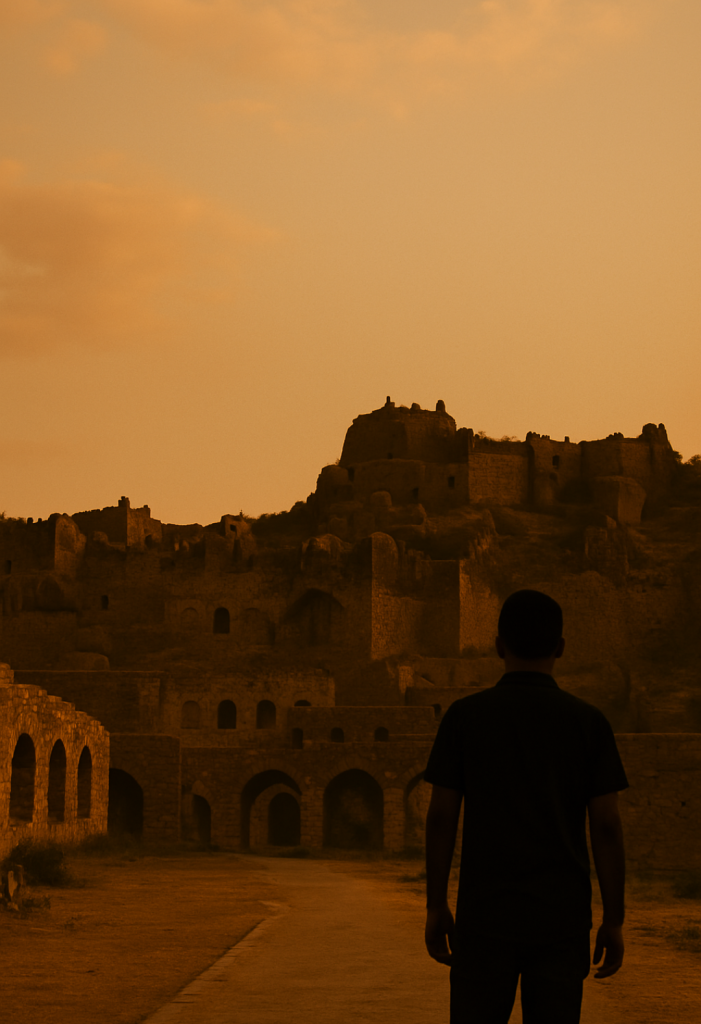
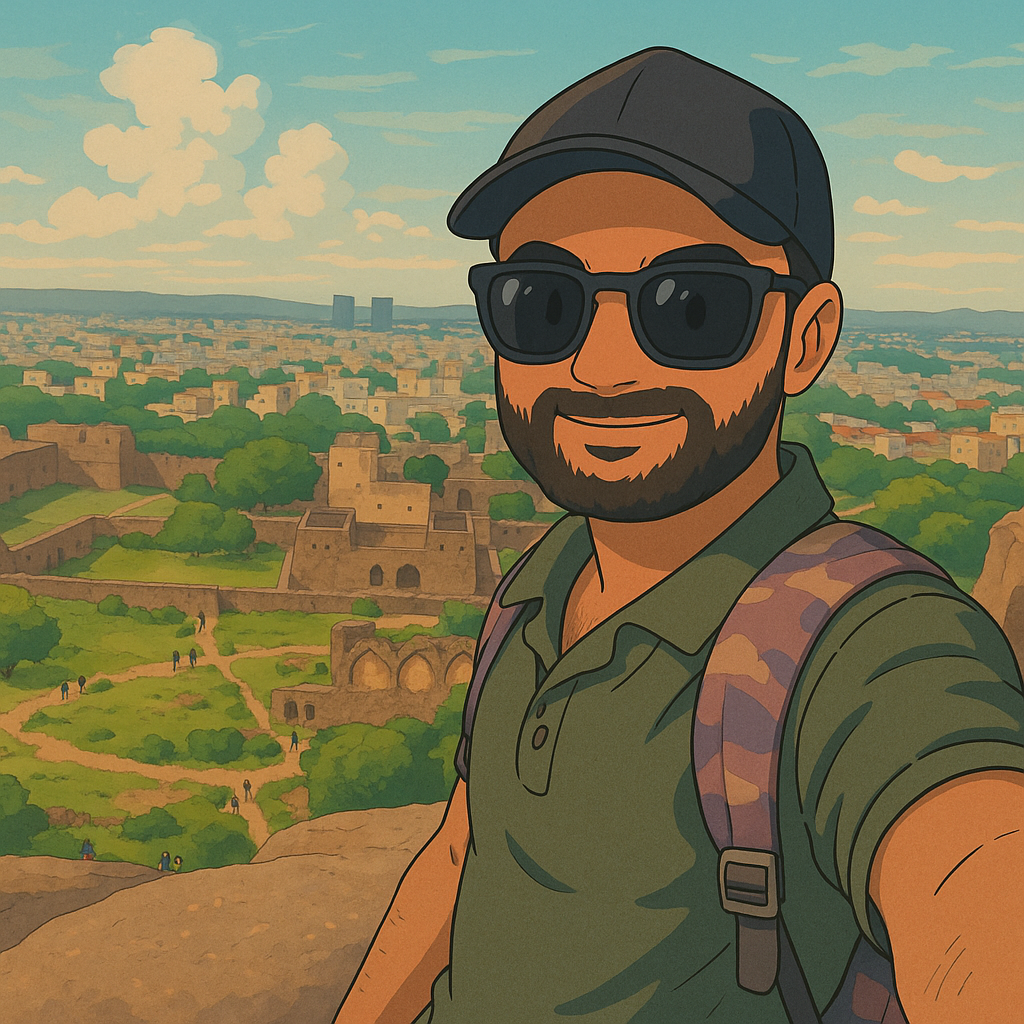
Fueled by a love for travel, I carved out a day to visit Golconda Fort, eager to see the architectural marvel I’d missed in Hyderabad.Upon my first glimpse, the fort’s majestic presence left me awestruck.I wandered through every corner, soaking in the details, until around 5:30 PM, completely captivated by the fort’s charm.
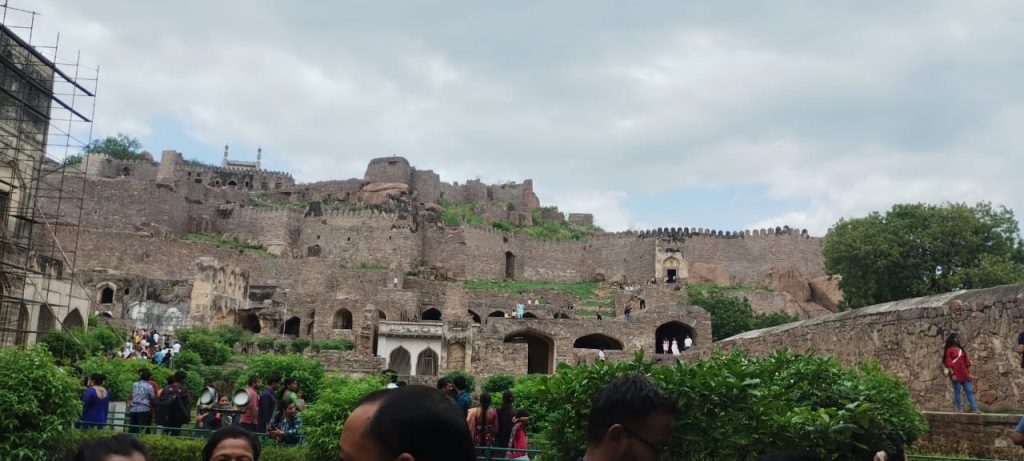
Rather than delving into the fort’s history or the kings who once ruled it—information readily available online—I wish to share only my personal reflections on its architectural marvels and the thoughts they inspired.
THE ARCHITECTURE:
Golconda Fort, a testament from centuries ingenuity, sprawls across acres in Hyderabad’s western expanse, shaped by the hands of multiple dynasties. Its design masterfully channels light and air, creating an airy, luminous interior. At the fort’s summit, the Royal Durbar offers a serene escape, where cool breezes refresh the senses and a panoramic view of Hyderabad unfolds, calming both mind and soul.
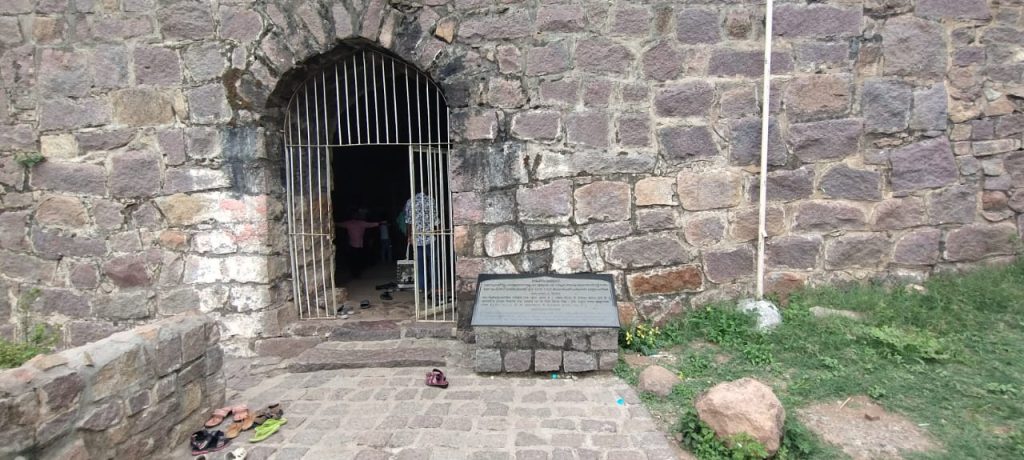
Among its treasures are the Ramdas Jail, the ingenious step wells, and the solemn mortuary bath, each a striking feature of the fort’s legacy.
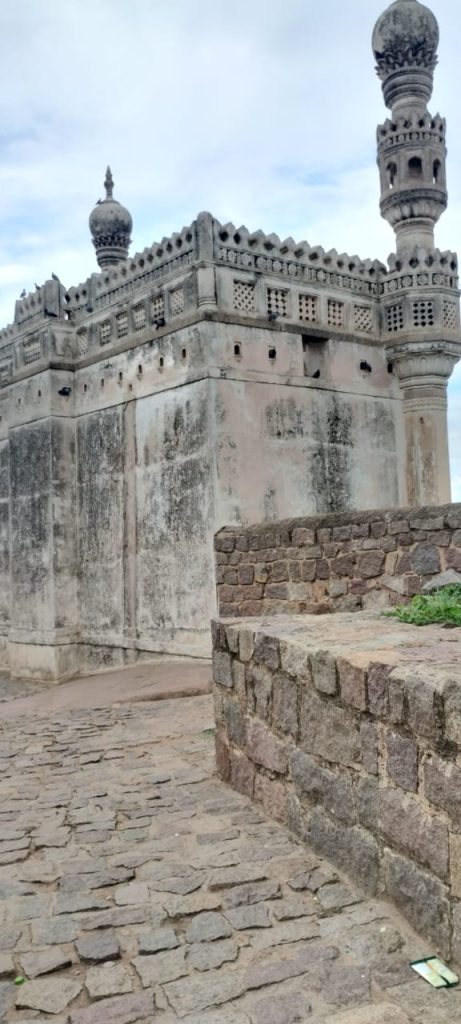
Equally remarkable is the acoustic phenomenon at Fateh Darwaza: a single handclap beneath the entrance dome resonates clearly at the Bala Hisar pavilion, nearly a kilometer away, once serving as a clever warning system against approaching threats.What struck me deeply was the fort’s embrace of diverse faiths, fostering a spirit of secular harmony. Within its walls stand the Ibrahim Mosque and the Jagadamba Temple, where the vibrant Telangana Bonalu festival begins, symbolizing a rare unity of traditions.
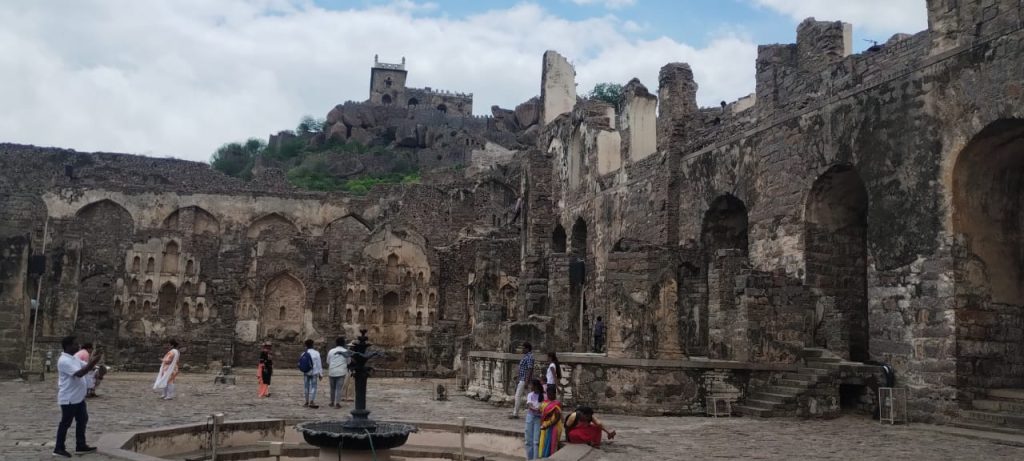
Beyond its celebrated architecture, now a cherished tourist site despite its ruins, Golconda Fort stirred profound questions in me. It prompted reflection, inquiry, and a deeper understanding of the human stories woven into its stones.
THE CIVIC SENSE:
While the fort’s beauty captivated me, the behavior of visitors raised concerns about our collective responsibility.
Golconda Fort, a beloved tourist destination, draws visitors from across India and beyond. It supports local livelihoods, with street vendors, auto-rickshaw drivers, and food stalls offering snacks, drinks, and popcorn, available even at the fort’s summit.So people brought a baggage of different food stuff before mounting onto the hill.
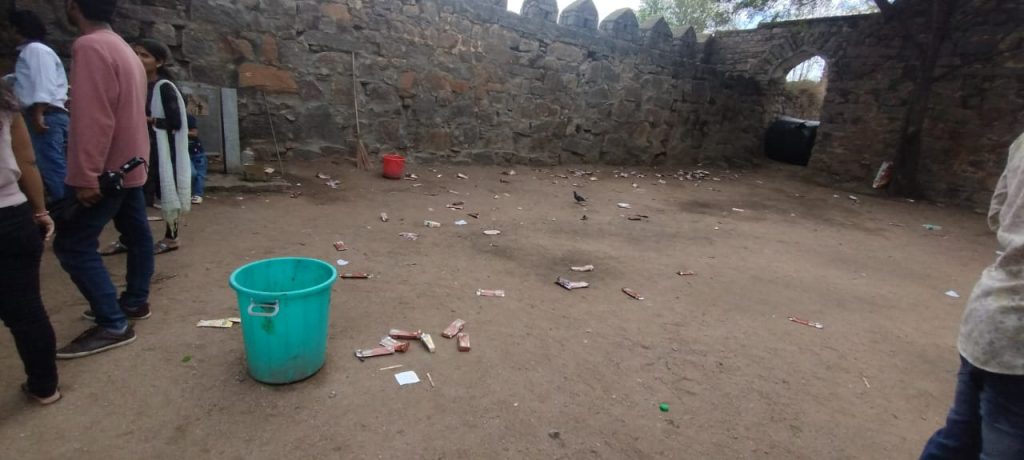
I felt observing civic sense in atleast Public places should become utmost priority…I noticed Empty dustbins stood ignored, surrounded by scattered plastic waste. Parents handed children ice cream, only to toss the empty cups carelessly, some even littering the fort’s sacred step well. Toilets were maintained, yet people misused open areas. No-smoking signs were clear, but cigarette smoke lingered, revealing our disregard for nature and heritage.
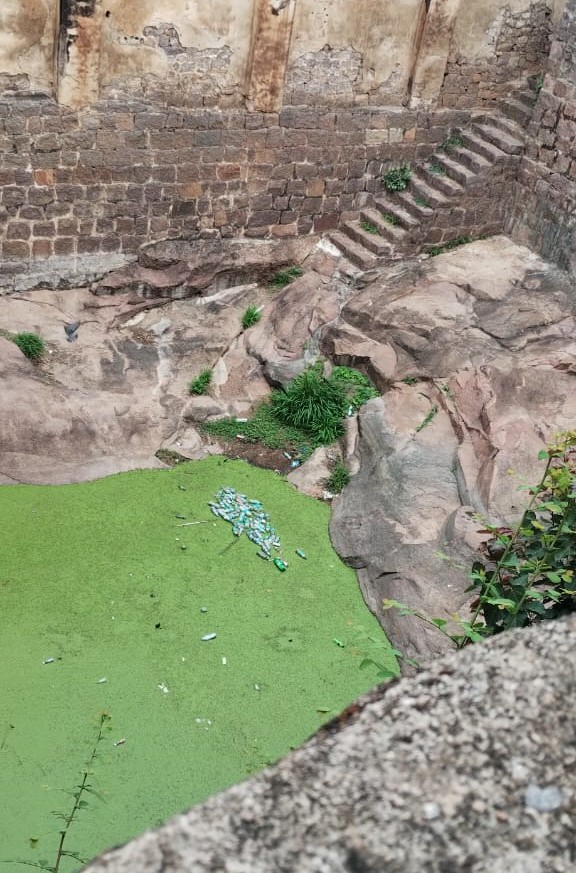
Raising the voice to protect Monuments and nature is appreciable but self practicing of minimum responsibilities are need of the hour.
What do you think about it…??
THE MYTH OF THE FEARLESS KING:
After Observing the imposing walls of Golconda Fort, stretching across acres, sparked a question in me: were the kings who built such fortresses truly courageous?
The fortified walls, vast armies, and elaborate defenses suggest not strength, but insecurity—a fear of enemies, betrayal, or rebellion. This led me to challenge the notion that kings were inherently brave, prompting a deeper look at their Let’s understand this by breaking some assumptions..
Assumption 1: The King is Powerful.
Reflection:
The image of a king as a powerful ruler is often celebrated with grand titles like Rajadhiraja, Maharaja, or Badshah etc…bestowed by subjects or even self-proclaimed. Yet, this power seems rooted in fear rather than strength. Kings built towering fortresses, like Golconda, to shield themselves from enemies.
They employed spies, wary of betrayal from ministers, soldiers, or even family. At night, they lay awake, haunted by the threat of future attacks.
If a king’s power is built on such suspicion and insecurity, can we truly call him courageous or deserving of such exalted names?
Assumption 2: The King Leads the Kingdom to Victory.
Reflection:
History often credits kings with glorious victories, but this narrative feels flawed. On the battlefield, it’s the soldier who stands at the forefront, risking and often losing their life, while the king remains protected behind the lines.
Shouldn’t history honor the soldier’s bravery over the king’s commands?
Moreover, what does a king’s victory truly mean if his people suffer—starving, oppressed, or yearning for freedom?
Wars are strategized by generals and fought by soldiers, yet the king reaps the glory.
Can we praise a king for triumphs built on the sacrifices of the innocent or for exploiting the labor of the poor to create architectural wonders?
Assumption 3: The King Protects the Kingdom from Enemies.
Reflection:
We’re often told that a king’s duty is to wage war to defend the kingdom. But whose wars are these?
Do they reflect the will of the people, or are they driven by a thirst for power?
In every war, it’s the innocent who pay the ultimate price—lives lost, sacrifices forgotten, and valor buried beneath the ambitions of rulers.
The history was written with those sacrifices Whose blood was lead in the battlefield.And that history Doesn’t have Guts to talk about this as the Blood knows no Emotions and Sacrifices. Wars are often fought for glory, to uphold a king’s dominance, or to project a false image of strength, demanding that people sacrifice their lives for a leader’s legacy.
If war is unavoidable, it should aim to restore peace and protect lives, but not to conquer other kingdoms or subjugate their people.
As Mahmoud Darwish poignantly wrote:
“The war will end,
The leaders will shake hands,
The old woman will keep waiting for her martyred son,
That girl will wait for her beloved husband,
And those children will wait for their heroic father,
I don’t know who sold our motherland,
But I saw who paid the price.”
Assumption 4: Kings Are Praised for Their Administration.
Reflection:
Some argue that kings deserve praise for their administrative achievements. But if their governance was truly exceptional, why did people reject monarchy and dictatorship, fighting instead for freedom and self-rule? Effective administration alone cannot justify a system that often prioritised the ruler’s power over the people’s welfare.
Assumption 5: Kings Are Celebrated for Their Magnificent Architecture.
Reflection:
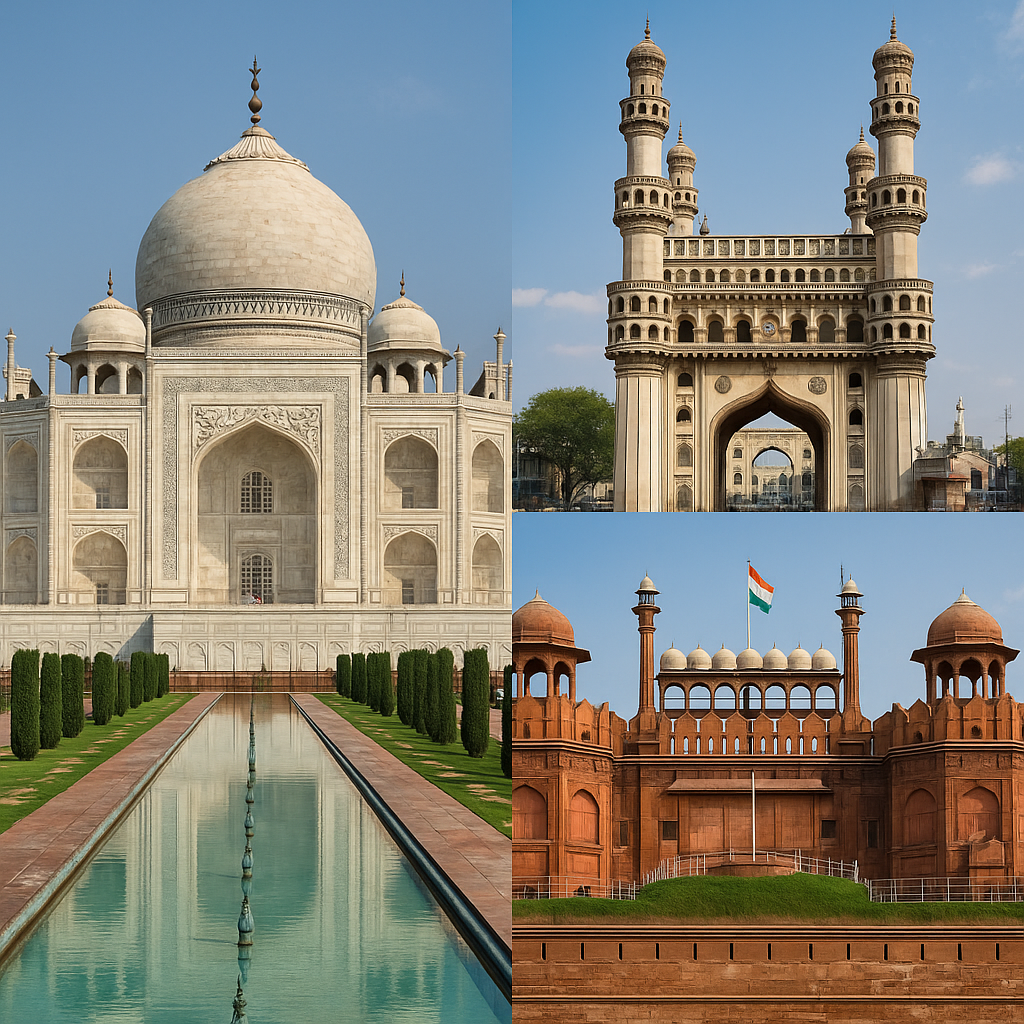
Kings are often immortalized for the grand structures built during their reigns, such as the Taj Mahal, Red Fort, or Charminar etc..Yet, who remembers the architects, engineers, and laborers whose skill and toil brought these marvels to life?
Few, if any, of us know their names or the ingenuity behind their work. History, as we learn it, credits the king, sidelining the true creators. .
Why do we accept this narrative so readily?
Beyond this, I do agree that history also sometimes records a few rare kings who prioritised their people’s welfare over war, living humbly and valuing innocent lives. Yet, I can’t help but feel these compassionate rulers were often struck down by others driven by conquest and ambition.
So why does history glorify kings?
What purpose does it serve to study their wars when we’ve long rejected monarchy?
Do these tales of conflict hold any relevance for us or our children today?
It’s time to question whether we study Political history merely because it’s tradition—or if there’s a deeper value we’re missing.
The ruins of kingdoms, not only the Golconda Fort but also many other still echo the names of kings, but they rarely speak of the soldiers and civilians whose lives were lost.
If we must remember history, let it be through the eyes of the unsung—the soldiers who fought, the innocents who suffered—rather than the crowns that commanded them.
What do you think..?.
A CHILD’S CURIOUSITY…
After I thoroughly enjoyed the fort seeing, before I leave the fort I stretched my legs to relax in the Garden over there…while I was writing some of my thoughts -I overheard a parent ask their nine- or ten-year-old child, “What did you learn from our visit to the fort today, my boy?”
The child, brimming with curiosity, replied, “I saw the beautiful structures, but I have big questions. Who carried all those heavy stones up here?How was it possible ?How did they build this place? ”
His mother was startled..!
Rakesh Kanikaram✍️
~27/05/2025



Leave a Reply